Wednesday, 10 January 2018

Call for papers: IRAQ special section on the life, work and legacy of Ethel Drower

Ethel Stephana Drower (1879–1972) was a pioneer of the anthropological study of Iraq’s minorities, especially the Mandaeans. She travelled widely, published prolifically, and earned the respect of her informants as well as her academic peers, despite her lack of formal academic training. Yet, beyond J.J. Buckley’s Lady E.S. Drower’s Scholarly Correspondence (Brill 2012), she has been little studied and is largely unknown outside the specialist field of Mandaean studies.

2019 will mark the 140th anniversary of Drower’s birth and the 85th anniversary of the first issue of IRAQ, to which she contributed (E.S. Drower, ‘Mandean writings’, IRAQ 1 [1934], 171–82). We propose to celebrate the occasion with a special section devoted to assessing Drower’s life, work, and legacy, co-edited by Erica Hunter, Augusta McMahon, Eleanor Robson, and Mark Weeden.

We invite papers of 5,000 to 10,000 words addressing topics and issues that might include (but are not limited to) the following in relation to Ethel Drower:

  • women’s lives in Mandate Iraq
  • Iraqi folklore and anthropology
  • Mandaean history and culture
  • the Mandaic language

The deadline for expressions of interest is 1 March 2018. Please email an anonymised one-page PDF to the Editors at e.robson @ ucl.ac.uk. Expressions of interest will be reviewed by the Editorial Board, which will issue invitations to submit papers by the end of that month.

The deadline for submission of invited papers is 1st September 2018. Please follow the submission instructions. All submissions will be double-blind refereed and up to six papers will be selected for publication in IRAQ 81 (2019). Authors will be informed of the outcome by the end of December 2018.

The Editors of IRAQ
Eleanor Robson, Augusta McMahon, and Mark Weeden
January 2018

Monday, 21 November 2016

Hatra lecture report

Hatra - An Arab Kingdom in Roman Times

Professor Wathiq Ismail al-Salihi
Wednesday 16 November 2016

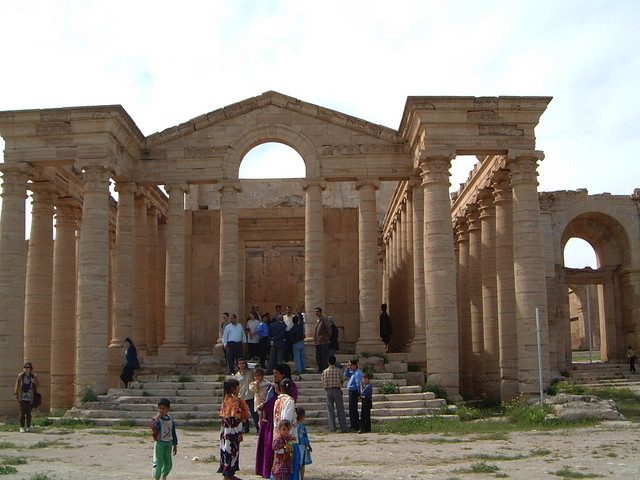
hatra facade

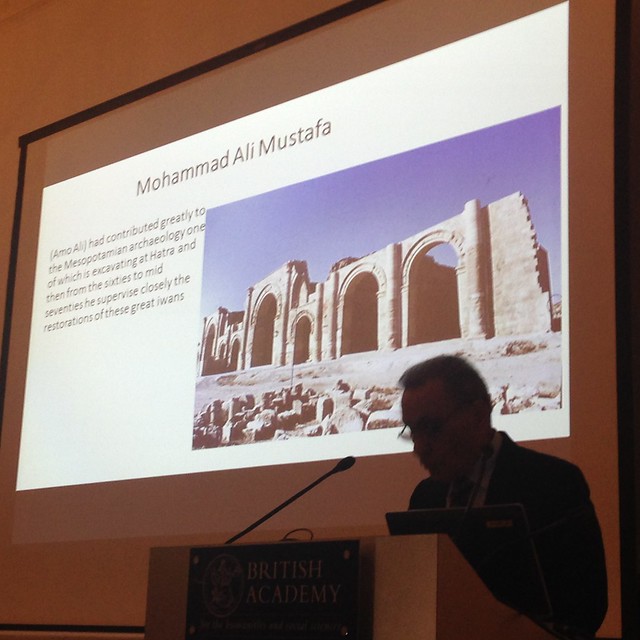
For a full house at the British Academy, Professor Wathiq Ismail al-Salihi gave a lecture in memory of Mohammed Ali Mustafa, the "sheikh of excavators in Iraq", sponsored by Dr Sabah and Mrs Sumaya Zangana.

Professor Al-Salihi spoke for over an hour about the ancient city of Hatra, where he had previously directed the excavations of various monuments and buildings. Situated a good 100 km to the southwest of Mosul, Hatra is said to have been located along a relatively minor trade route and the existence of its tribal society depended on access to the available water resources through wells.

Throughout his talk Professor al-Salihi emphasised what he called the formidable fortifications of the city, whose defence system famously withstood the attacks of two Roman emperors, Trajan and Septimius Severus, before finally falling (around AD 240) to the Sasanians, who had established themselves as the major power in the region after defeating the Parthians. The circular walls were 3 m wide with mudbrick on foundations of hewn stone, and curtain walls of hewn limestone slabs were added. A large moat, 4-5 m deep and 8 m wide, surrounded Hatra. A bridge over the moat, supported by an arch, was leading to an entrance into the city. Close to the gate, the number of buttresses increased. According to later Arab authors, Hatra’s walls were protected by talismans. A gorgon head decorated the fortifications. A ballista (stone thrower) that was used in the defence against Severus was found near the North Gate.

In the gates, with their lateral opening, were niches containing statues of an apotropaic deity commonly identified as Heracles-Nergal. A relief of an eagle stood above legal texts concerning the death penalty as a punishment for theft: a thief from outside Hatra would be stoned to death, whereas a thief from within the city would die the enigmatic ‘death of the god’ (see also T. Kaizer, ‘Capital punishment at Hatra: gods, magistrates and laws in the Roman-Parthian period’, Iraq 68 (2006), p.139-153).

Many of Hatra’s monumental buildings were constructed during the long reign, in the first half of the second century AD, of the local lord Nasru. He left two images of himself, inscribed with his name, on the voussoirs of one of the iwans, the large vaulted structures that are so characteristic of Hatrene architecture and are dedicated to the members of the local triad (Maren - ‘Our Lord’; Marten - ‘Our Lady’; Bar-Maren - ‘the Son of Our Lord’) and to other deities such as Shahiru - the Morning Star. The later king Sanatruq, together with his son Abdsmya, was responsible for the magnificent temple of Allat. Musical scenes of what has been interpreted as Dionysiac ritual decorated the sanctuary on the inside. The two central reliefs depict the goddess herself. On the first, Allat is welcomed, riding on a camel, by a nymph holding a balance. On the second, the goddess is seated on the lever of this same balance, a symbol of her justice. King Sanatruq approaches the goddess, and a model of the temple is presented to her.

Fourteen shrines were excavated elsewhere in the city, including no.XII to Nebu and no.XIV to Nanai. Finally, Professor al-Salihi showed images of a mural painting found in the North Palace, which he interpreted as an image of Aphrodite at her bath, as inspired by the Sixth Homeric Hymn.

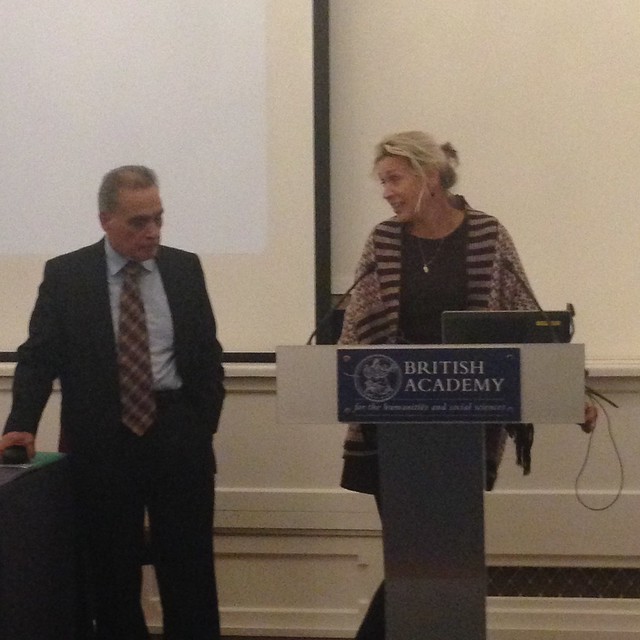
Dr Lucinda Dirven thanks Professor Wathiq Al-Salihi at the end of the lecture

Dr Lucinda Dirven of the University of Amsterdam, editor of an important recent volume on Hatra (L. Dirven (ed.), Hatra. Politics, Culture and Religion between Parthia and Rome [Oriens et Occidens 21] (Stuttgart: Franz Steiner Verlag, 2013)), gave the vote of thanks.

Ted Kaizer, Durham University (ted.kaizer@durham.ac.uk)

Photos by Eleanor Robson

Saturday, 19 November 2016

BISI Statement on Nimrud

Now that the Iraqi army has regained control of the ancient Assyrian capital city of Nimrud, the scale of the destruction by ISIS has become clear. It was known through an obscene propaganda video that in April 2015 the palace of Ashurnasirpal II, from the 9th century BC, with its contents of invaluable Assyrian reliefs was destroyed in a massive explosion. Now we learn that other buildings have been badly damaged and the ancient ziggurat has been levelled.

The British Institute for the Study of Iraq has a long association with Nimrud, having undertaken seminal excavations there from 1949 to 1963, and the President of BISI excavated there in 1989.

In this tragic situation BISI extends our greatest sympathy to our Iraqi friends and colleagues, and stands ready to provide any help that it can to the Iraqi State Board of Antiquities and Heritage.

To learn more about Nimrud and BISI's long-standing involvement with the site, please visit the Nimrud Project website.

Professor Eleanor Robson, Chair of Council
Dr Paul Collins, Chair-elect of Council
Dr John Curtis, President

Tuesday, 27 September 2016

Basrah Museum opens its first gallery


BISI is delighted to share this press release from the Basrah Museum and the Friends of Basrah Museum:


A new museum celebrating the rich cultural heritage of southern Iraq has opened its first gallery at a ceremony in Basrah today. The gallery, which displays artefacts from the Hellenistic period (c. 300 BC) through to the present, represents the first major milestone in an eight-year project involving the Iraq Ministry of Culture, the State Board of Antiquities and Friends of Basra Museum, a UK-based charity which was set up in 2010 to provide financial, project management and curatorial support to the museum.

The new Basrah Museum is housed in the former Lakeside Palace in a park by the Shatt Al Arab. It will be a major cultural resource, not only for the city of Basrah but also for Southern Iraq and the wider region. Galleries will focus on the area’s archaeology and history from prehistory down to the development of Basrah as a major trading port (from which Sinbad the Sailor is said to have set sail), renowned as a centre of scholarship, education, poetry and music.

‘This is a great day for Iraq’s cultural heritage,’ said Minister of Culture Faryad Raundozi. ‘It is an important example of how the international community can work with Iraqi experts and institutions to improve the way we conserve, celebrate and protect our past.’

Chairman of the State Board of Antiquities and Heritage Qais Rasheed said: ‘We are delighted that Basrah now has a museum which can properly tell the story of this great city’s past. We will continue to add more artefacts to the exhibition and to build our collaboration with international organisations to better understand the region’s archaeological sites and to improve the training and support for researchers and students’.

Director of Basrah Antiquities and Heritage, Qahtan Alabeed said: ‘This is a very special day for us. It couldn’t have come about without the support of a great number of people – especially the Friends of Basrah Museum and their principal funders BP. I also want to acknowledge the dedication of colleagues in Baghdad and Basrah, which means we’re able to display many exhibits in public for the first time in years.’

British Ambassador Frank Baker said: ‘The Basrah Museum reminds us of the depth of the history of Iraq, and the great achievements of its people. It is also an example of what the UK and Iraq can achieve when they work together – so much time and energy has been put in by the Friends of Basrah Museum to reach this stage. My team and I look forward to visiting over the coming weeks, to see its use as a cultural and educational centre.’

Sir Terence Clark Chairman of the Trustees of the FOBM, said: ‘This is the culmination of years of quiet persistence on the part of the Trustees and the Museum staff. All of us at FOBM recognise the global importance of Iraq’s cultural heritage and have been determined to do what we can to support those in Iraq who are working to see it properly managed.’

BP was the principal donor to the project, with a grant of $500,000. Michael Townshend, BP Middle East’s Regional President, said: “In every region in which BP operates we look to support and protect the local culture and heritage. When we were approached to support the establishment of this new museum for Basrah, we wanted to help. We are glad that the people of Basrah will now have a museum which celebrates their rich cultural history.”

The opening is followed by a two-day conference at the museum, organised by the British Institute for the Study of Iraq. After that, work will continue on the refurbishment of the rest of the museum. It is hoped that it will set a standard for the whole country, with facilities for school parties and contents tied to the Iraqi national curriculum. New educational programmes, supported by the British Council, will be introduced in October to local schoolchildren.

Editorial note
The Friends of Basrah Museum is a UK-registered charity established in 2010 to raise funds for the Basrah Museum and to provide support to its Director, Qahtan Alabeed. The trustees are Sir Terence Clark, Dr John Curtis, Liane Butcher, Clare Bebbington, Dr Lamia al-Gailani, Dr Salah al-Shaikly and the Hon Alice Walpole.
As well as FOBM and BP, the project has been supported by The British Institute for the Study of Iraq; The British Museum; Petrofac; The Charlotte Bonham Charitable Trust; HWH Associates; Bur Alaman; IPBD Ltd; Control Risks Group; Field Energy Services; Pulse Brands; and private individuals.

FOR MORE INFORMATION

Clare Bebbington, Friends of Basrah Museum – tel: +44 7403006106

Wednesday, 6 July 2016

Joint submission to the Chilcot Enquiry

Back in January-February 2010, Peter Stone of UK Blue Shield co-ordinated a joint submission to the Chilcot Enquiry. The submission is referred to in paragraphs 801-826 of the Chilcot Report, published today, but I can't find it on the Iraq Inquiry website. As a contributor to, and editor of, that report (though not a signatory — I was Vice-Chair of BISI's council at the time), and as it was always meant to be a public document, I thought I'd post it here, along with the cover letter and press release issued with it, on 17 February 2010.

These documents were submitted on behalf of:

  • UK National Commission for UNESCO
  • British Academy
  • British Institute for the Study of Iraq
  • Council for British Archaeology
  • European Association of Archaeologists
  • Institute for Archaeologists
  • International Council on Monuments and Sites UK
  • International Council of Museums UK
  • Museums Association
  • National Trust
  • Nautical Archaeology Society
  • Society of Antiquaries of London
  • UK & Ireland Committee of the Blue Shield.

Friday, 6 May 2016

Investigations at Alexandria-on-the-Tigris, aka Charax Spasinou 


Robert Killick was awarded a BISI Research Grant to conduct preliminary investigations at Charax Spasinou. You can find out about the first season of survey in the report below.

Few names from the ancient world resonate quite so loudly in the modern era as that of Alexander the Great. When in spring 2015 we were invited by the State Board for Antiquities and Heritage to work at a city founded by Alexander, we could scarcely refuse. One year on, we have just completed our first season of survey at Alexandria-on-the-Tigris, known later as Charax Spasinou. That we were able to respond so swiftly to the request is entirely due to the generous support of, among others, Baron Lorne Thyssen-Bornemisza at the Augustus Foundation, the State Board for Antiquities and Heritage, the Foreign and Commonwealth Office and, of course, BISI itself.

Along the ramparts at Charax Spasinou


Alexander sailed down the Eulaeus River from Susa in 324BC, and came to its confluence with the Tigris. At that time, access to open water and the Gulf was also close by. The strategic advantage of the place was obvious, and so Alexandria-on-the-Tigris was founded. Unfortunately, Alexander didn’t realise just how prone to flooding the entire region was (and in fact remained so until the construction of the Hindiya Barrage in the 1950s). After devastating floods, the city was twice re-founded, once as Antiochia in 166BC and again in 141BC as Charax Spasinou. As the latter, it became the capital of the Kingdom of Characene and a major trading emporium, exchanging goods with India, Palmyra, Petra, and onwards to Rome.

The remains of Charax Spasinou (modern Khayaber) lie some 40 km north of Basra. The ramparts rise to four metres above the plain, complete with bastions at regular intervals. To the south, the old course of the Eulaeus River is clearly visible and we estimate that the remains of the city are spread over an area of about five square kilometres. Debris from the Iraq-Iran war still litters the archaeological site and some areas have been badly disturbed by old military installations. Erosion, agricultural activity and looting continue to be threats.

Working at such a large site presents some interesting challenges. How do you survey and map such a large area, for example? Even with our modern surveying instruments, this would be a lengthy and arduous task. Fortunately, the use of a drone combined with mapping software provided a solution. Flying at a height of 100 metres, our drone took 5,000 photographs over nine days, covering an area of some eight square kilometres. These images are now being compiled into a digital elevation model which will be used to generate topographical maps, including a contour map and shaded relief maps.

Finding out how much archaeology is left at Charax after two thousand years of repeated flooding was another challenge. Here geophysics came to our rescue: armed with a caesium magnetometer, one of the world’s leading experts, Dr Joerg Fassbinder, with his team from the University of Munich, surveyed over eight hectares in ten days. The results were beyond expectations: entire districts of the city were revealed below the surface, including substantial public buildings and residential houses. The orthogonal plan produced by the survey clearly reflects the original lay-out of the Hellenistic city, one which was retained in succeeding periods.

The Hellenistic town grid and large buildings are clearly visible on this geophysics plot


An evaluation trench placed across one of the district boundaries found a ditch with mud-brick walls running parallel on both sides. A puzzling feature was a row of Parthian torpedo jars set upside-down in a solid layer of clay. The tips of the bases had been deliberately and neatly cut away, leaving entry holes at the top. Two further evaluation trenches found walls belonging to two of the large buildings that showed most clearly in the magnetometer survey.

A row of Parthian torpedo jars lining a ditch 


The logistical challenges of working at Charax are substantial, but these preliminary results have more than repaid the effort. Our mission for the future will be to implement a comprehensive research and excavation strategy that will do justice to this important Alexandrian city.

Robert Killick
Honorary Fellow,  Manchester University


Tuesday, 2 February 2016

Cultural Protection Fund: a positive ministerial response

I'm happy to report that we've received a reply to the collective letter sent last November, which outlined BISI's, and others' views on how the government's proposed Cultural Protection Fund should work, in support of the UK's promised ratification of Hague 1954.

The letter, written by Ed Vaizey, Minister for Culture and the Digital Economy, reads in full:

Thank you for letter of 24 November 2015 to the Secretary of State for Culture, Media and Sports, The Rt Hon John Whittingdale MP. I am responding as the Minister responsible for this policy area and I apologise for the delay in replying.

We are delighted to receive you and your colleagues’ support for our plans to ratify the 1954 Hague Convention and its two protocols, and for the Cultural Protection Fund.

The Department is firmly committed to introducing new legislation to enable the UK to ratify the 1954 Hague Convention and its two Protocols at the earliest opportunity. We believe that doing so will ensure the UK and its cultural experts and practitioners in the field are seen to be not only serious about cultural protection, but world leaders in this area.

On 25 November 2015, as part of the Spending Review, we were delighted that the Chancellor of the Exchequer announced £30million in Official Development Assistance funding for the establishment of our Cultural Protection Fund. Planning is currently underway towards implementing the Fund with the expectation of accepting grant applications in the spring.

We have sent out our consultation document to you and your co-signatories, and would warmly welcome your views on the Cultural Protection Fund. Your expertise would help inform its further development. In addition, we are holding a stakeholder workshop on 11 February which I believe a number of your co-signatories are attending.

I have taken Peter Stone’s points and your support of them into serious consideration - and it is precisely such strategic thinking and expertise which we are seeking with our consultation. I agree entirely with the principles behind the points on combatting duplication of effort; on the need for training; proactive prevention; emergency response; and long term support. These points cohere with the principles of the Fund as outlined in our consultation document, and correspond with the outcomes I announced at the Cultural Protection Summit of 28 October 2015, namely: cultural heritage protection, training, and advocacy and education. Indeed, the British Museum’s Iraqi Rescue Archaeology Programme, a pilot programme of the Fund, is already adhering to these aims, and we will be encouraging grant applications from other programmes and organisations who can provide services pursuant to these outcomes.

We will be providing further information about the Cultural Protection Fund and on the Government’s approach to ratifying the Hague Convention in the spring of this year.

Thank you again for your support and your offer of assistance in this area. I do very much hope that you will respond to our consultation document and am delighted that some of the signatories have made to time to come along to our workshops.

Best wishes,

Ed Vaizey MP
Minister for Culture and the Digital Economy

Wednesday, 9 December 2015

BISI Student Poster Competition 2015
Interview with the Winner – Daniel Calderbank

BISI held its first Student Poster Competition in autumn 2015 for UK undergraduate and postgraduate students, engaged in the study of the lands and peoples of Iraq. First prize went to Daniel Calderbank, a PhD student at Manchester University, for his poster on ‘Everyday Life in the Babylonian ‘Dark Age’: new ceramic evidence from Tell Khaiber, southern Iraq.’


A bit about you first, Daniel! Where are you studying, and what stage are you at in your research?
I’m a PhD student with the Archaeology department at The University of Manchester, and am currently part way through my second year of a three and a half year project. My research is funded by the Arts and Humanities Research Council (AHRC).

How did you become interested in studying ancient Iraq?
My first encounter with the archaeology of ancient Iraq came in an undergraduate seminar titled The Origins of Urbanism, led by my now supervisor Prof. Stuart Campbell. The focus of the seminar was the site of Uruk, widely held as the world’s first true city. I remember being astonished by the rapid development of the site, reaching an incomprehensible scale by the late 4th millennium BC, almost a whole millennium prior to the construction of the British monuments, such as Stonehenge and Avebury, with which I was at that time most familiar.

At that point, I could hardly have envisaged myself setting foot on the famous mounds of the Eanna Precinct. Having the opportunity to visit Uruk in 2014 was an experience that truly reawakened those early feelings of astonishment and wonder.

View of the Eanna Precinct from the ruins of the Uruk ziggurat Photo: Mary Shepperson


Could you tell us a bit about your research project?
Mesopotamian history can often read like a narrative of grand politics, with one power succeeding another in endless procession. The site of Tell Khaiber, situated 20km southeast of Ur, accordingly occupies a period of widespread political instability, punctuated by the collapse of the First Babylonian Dynasty and the emergence of the elusive Sealand Dynasty (c.1600-1400 BC).

In an archaeological climate traditionally consumed by such top-down accounts, my research looks to interpret the more situated, everyday lives of the Khaiber inhabitants. I contend that a functionally driven analysis of 2nd millennium pottery can provide a unique basis from which to reconstruct the everyday patterns of behaviour that animated Babylonian social life. By identifying episodes of routine and more specialised food and drink consumption, I hope to articulate the ways in which past identities were created, performed, maintained, and manipulated.

Excavating a double-pot burial with Prof Stuart Campbell Photo: Jane Moon


What did you find the most challenging aspect of making your poster?
The trickiest aspect was unquestionably striking the right balance between images and text. As PhD researchers, we are often programmed to communicate in words, especially when explaining our complex methodologies. When designing something eye-catching, however, this tendency must be curbed. Of course, the indirect benefit of this is that it forces one to be concise.

Do you have any tips for people thinking about studying Iraq?
Iraq is a wonderfully diverse country, topographically, demographically, and archaeologically. I would urge any prospective student to talk with as many people familiar with the country as possible, whether that is people who have lived and worked there, or people who simply observe it from afar. By immersing yourself in Iraq’s culture, you will no doubt develop a great appreciation for its past!


BISI’s Student Poster Competition aims to offer UK students the opportunity to present and discuss the innovative and creative research that they are undertaking with both the academic community and the wider public and to raise the profile of their research. We welcome applications from the full range of arts, humanities and social sciences subjects, covering any time period, from prehistory to the present day. To find out more and to sign up to receive updates about future competitions, please contact the BISI Administrator on bisi@britac.ac.uk

Tuesday, 24 November 2015

Open letter to the UK Culture Secretary, John Whittingdale

In the latest round of the UK Blue Shield-BISI campaign for the ratification of the 1954 Hague Convention, today I sent the following open letter to UK Culture Secretary John Whittingdale, encouraging him to act on the announcement he made last June.

Rt Hon John Whittingdale
Secretary of State for Culture, Media and Sport

November 2015

Dear Mr Whittingdale

Ratification of the 1954 Hague Convention
and the UK Cultural Property Protection Fund

As representatives of some of the UK's leading cultural heritage organisations we, the undersigned, were delighted when last June the Government publicly announced its decision to ratify the 1954 Hague Convention for the Protection of Cultural Property in the Event of Armed Conflict and its associated protocols. This legislation will give enormous support to the Armed Forces’ ambitions to support local communities in the areas in which it is militarily engaged.

We are also hugely supportive of the Government's intention to create a Cultural Property Protection Fund, as announced in the same press release. In particular we endorse the proposal that has already been put to you by Peter Stone, UNESCO Professor of Culture Property Protection and Peace at Newcastle University, Chair of the UK Committee of the Blue Shield and cultural property advisor to the UK Government during the Iraq War of 2003. He recommends that the Fund be concentrated on five areas of activity, namely:

  • A co-ordination centre, with a staff of three or four, to act as a practical hub for networking, liaison, and communication for the complex web of academic, NGO professional, governmental, and military expertise in the area, to ensure minimal reduplication of effort. This is, in our opinion, the top priority for funding now.
  • Training for individuals and organisations in the practicalities of Cultural Property Protection, facilitated by the co-ordination centre.
  • Developing and implementing procedures for proactive protection of Cultural Property for countries such as Lebanon, which are at under real risk, where proactive protection could be implemented now and from which international guidelines could be developed.
  • Emergency response protocols to deliver rapid, specialised assessment and initial conservation first aid to countries suffering from conflict or environmental disaster.
  • Long-term support for Cultural Property in post-conflict and post-disaster zones, such as post- earthquake Nepal.

We thank you again for all your efforts to make the UK a leader in international Cultural Property Protection and look forward to concrete news soon of the parliamentary schedule for ratification, and of the budget and remit of the Cultural Property Fund. We would be happy to be of assistance in any way we can.

Yours sincerely,

Professor Eleanor Robson
Chair of Council
British Institute for the Study of Iraq

Dr Mike Heyworth, MBE
Director
Council for British Archaeology

Mr Peter Hinton
Chief Executive
Chartered Institute of Archaeologists

Ms Sharon Heal
Director
Museums Association

Ms Kate Pugh, OBE
Chief Executive
The Heritage Alliance

Mr Julian Radcliffe
Chairman
The Art Loss Register

Dr Neil Brodie
Scottish Centre for Crime and Justice Research
University of Glasgow

Professor Sir Barry Cunliffe
Emeritus Professor of European Archaeology
University of Oxford

Mr Philip Deans
Doctoral Research Student
School of Arts and Cultures
Newcastle University

Dr Paul Fox
University of York

Dr Nigel Pollard
Associate Professor of Ancient History
Swansea University

Mr Robert Bevan
Architecture Critic of The Evening Standard

Dr Bijan Rouhani
Vice Chair
ICOMOS Working Group on Syria and Iraq

Mr Peter A. Clayton
Member of the Treasure Valuation Committee
The British Museum

Dr Robert Bewley
Project Director
Endangered Archaeology of the Middle East and North Africa Project
University of Oxford

Professor Graham Philip
Department of Archaeology
Durham University

You'll also find this letter on the Facebook pages and Twitter feeds of UKBS and BISI, for you to like and share. You're equally welcome to redistribute it in any other convenient way, but please let us know, for the record if you so.

As always, I'll post an update as soon as I have news.

Wednesday, 5 August 2015


Remembering Gertrude Bell


Last month Belinda Lewis, Charge d'Affaires, British Embassy Baghdad paid a visit to Gertrude Bell's grave in Baghdad, leaving a tribute from BISI and the British Embassy.

BISI was founded in memory of Gertrude Bell in 1932. An explorer and archaeologist, Bell was instrumental in the foundation of the Iraq Museum.

BISI joined forces with the British Academy in 2013 to hold a conference examining the many facets of Bell's legacy in Iraq, including her role in the making of the Iraqi state. 

At the Gertrude Bell Archive, Newcastle University, you can read Bell's digitised diaries and letters, and her beautiful photographs from her travels in Iraq and the Middle East. 

Belinda Lewis with the care-taker who has tended the cemetery
where Gertrude Bell is buried since the 1940s


Thursday, 9 July 2015


Looted in Syria - and sold in London:
 the British antiques shops dealing in artefacts smuggled by ISIS 

BISI Trustee, Dr Mark Atlaweel goes under cover with the Guardian to hunt for 'blood antiquities' in London dealerships. Relics from the ruins of Palmyra and Nimrud are now on display in British shops - and so far no-one has worked out how to stop it. 

Read the full article by Rachel Shabi 

Dr Mark Altaweel BISI Trustee and Lecturer in Near Eastern Archaeology at UCL 

Wednesday, 24 June 2015

4th BABYLON FESTIVAL FOR INTERNATIONAL CULTURES AND ARTS 

Richard Dumbrill was awarded a BISI Conference Grant in 2015 to attend the 4th Babylon Festival for International Cultures and Arts. You can read about the event in the report below. 

The New Babylon Festivals (Babylon Foundation) were initiated four years ago by Dr Ali ash-Shallah, MP for the province of Babylon, presently Director of Media for the Republic of Iraq, and an acclaimed poet.

   There is no relation whatsoever between the Babylon Festivals organised by Saddam Hussein and the present occurrences. The new festivals include international cultural exchanges, devoid of any propagandist events, and integrate all forms of the arts and cultures without any political, religious, or other dictates. It is all about peace, human rights, gender equality, reconciliation. One of the objectives of the festivals is the inclusion of the site of Babylon in the UNESCO World Heritage List from which, astonishingly, it has been excluded to this day.

   The Babylon Foundation which organise the Babylon Festival also work actively in the restoration of 'Abbasid, and Ottoman architecture and have just completed the reconstruction of a typical late Ottoman house in Old Baghdad (Abu Nuwas) which is now the site of concerts, exhibitions as well as offering accommodation for international students, scholars and artists.

   The main events of the festival take place in the 'neo-hellenistic' theatre at the site of Babylon where around 1,500 spectators gather for both opening and closing evenings. All other events take place either in the museum courtyard at the site of Babylon, at a school at Hillah and in other local theatres. Participants of the festival are usually hosted in the palatial infrastructures built, in the gardens of Babylon just below Saddam Hussein’s outrageous palace built on top of an artificial tell. The well-worn apartments are still furnished with Husseinian taste.

   The Babylon Festivals are covered by the Iraqi national and other TV channels and by the daily local and national press. The Festivals are highly regarded throughout the country and appease differences through a shared culture.

   One of the main concerns with the Babylon festivals is funding which is a difficult task in a country at war, and where the conservation of culture is felt as a luxury that people cannot afford.

   The BISI grant enabled myself, Ahmed Mukhtar (Oud master) and Dr John Macginnis (Current BISI Council Member) to travel to the festival to give a lecture to students of archaeology of Babylon University, in the museum yard at the site of Babylon and we were invited by the chancellor of the university, Professor al- Baghdadi, to speak at the main lecture theatre of the university which was packed with professors and students. The event was presented on national television.

  The focus of my talk was on the contribution of Akkadian, Babylonian and Assyrian theory of music, to the development of Western music.

    During the Akkadian Period, mathematical cuneiform texts excavated at the Temple Library of Nippur, by Wolfram Hilprecht at the beginning of the twentieth century and dated from about 2300 BC, showed lists of regular numbers* extracted from the sexagesimal mathematical system. These numbers gave values to the nine notes of the Akkadian scale: 36; 40; 45; 48; 54; 60; 64; 72 and 81. Most interestingly these numbers can be taken as units of string lengths or reciprocally as units of frequency. The ratios which they generate between them, that is 40/36, can be converted into musical cents, a method developed in the late nineteenth century by Alexander John Ellis, from an earlier eighteenth century method devised by the French scientist Prosnier. 40/36 = 182 cents which is the minor tone; 45/40 = 204 cents which is the just major tone and 48/45 = 112, which is the semitone. These numbers which were conceptualised over 4,000 years ago give the exact values of the harmonic, or natural scale, a scale which was invented about 1,500 years before Pythagoras was born.

   The Old Babylonian period produced a tablet excavated from the site of Ur by Sir Leonard Woolley. (Fig. 1) This text is a method by which nine different scales, or sets, can be generated from a fundamental set by simple re-arrangement of some of the pitches in each set. The resulting scales have been wrongly named 'modes' by some scholars, for reasons which are beyond the purpose of this short text. Other texts were written during the Assyrian period, in the first millennium, but would have been copies of much earlier Babylonian originals. These texts give the names of intervals of fifths and thirds which were the forerunners of the Arabian Ajnas of the Maqam system. Another cuneiform text of unknown provenance, hosted at the University Museum of Philadelphia (Fig. 2) has the earliest evidence for the construction of a heptatonic scale system of eight 'modes' in all points similar to the seven liturgical 'modes' of our Western Middle Ages. The tablet has a drawing etched onto it describing a tuning device consisting of two discs rotating one against the other to generate the seven modes based on the heptatonic system. (Fig 3) This tablet is the earliest evidence of the construction of a heptatonic scale by means of alternation of fifths and fourths, much before Euclid.

Fig.1
Fig.2 
Fig 3.


    It has become evident that Greek scholars having visited the city of Babylon from the eighth century BC, to study, during what is called the Orientalizing Period, and brought back to Athens the Babylonian system which further spread to the West in the course of time, and ended up in the liturgical systems of Christendom, as well as in the Synagogues.

Richard Dumbrill
Director of the International Conference of Near and Middle Eastern Archaeomusicology &

Advisory Board Member of the Babylon Foundation

Sunday, 21 June 2015

UK government to ratify #Hague1954!

I'm delighted to report that the UK goverment issued a press release today announcing its intention to ratify the 1954 Hague Convention on the Protection of Cultural Property in the Event of Armed Conflict.

So many people have been involved in UK Blue Shield and BISI's campaign to bring this about — not least every single person who has written to their MP expressing their concern. Thank you everyone!

Monday, 18 May 2015

Help us get #Hague1954 ratified in the UK!

Following the UK General Election on 8 May, BISI is supporting UK Blue Shield's new campaign to persuade Parliament to ratify the 1954 Hague Convention as soon as possible.

It's been a long slog: every government agrees in principle but none gets around to putting it into practice. Let's make it happen now!

Please get involved by writing to your recently (re-)elected MP asking them to take up ratification at the earliest possible opportunity.

Here is a draft letter that you can simply send to your MP, or that can be adapted as necessary, and a list of bullet points if you would prefer to write your own letter. They were drafted by Professor Peter Stone, the Chair of UK Blue Shield.

If you do not know the name of your MP or how to contact them, you can find their details on the UK Parliament website. If you would like to write to your local newspaper that would be wonderful as well.

To help us keep track of the campaign, please tell us when you write to your MP, or your local press, by:

  • Leaving a comment below this post;
  • Leaving a comment on the UK Blue Shield's Facebook page
  • Or, if you use Twitter, sending a tweet to @UKBlueShield with hashtag #Hague1954 — and tweet to your followers too!

Please also encourage anyone you know to write to their MP. Use Twitter (#Hague1954), Facebook, email, good old-fashioned letters — whatever it it takes to tell our elected representatives why this matters so much.

Sample letter to your MP

Dear [MP'S NAME]

1954 Hague Convention on the Protection of Cultural Property in the Event of Armed Conflict and its two Protocols of 1954 and 1999

May I congratulate you on your recent election and ask that you take action on a very topical and urgent matter.

The Hague Convention is the primary piece of International Humanitarian Law concerning the protection of cultural heritage during conflict. While the world reacts in horror to the appalling destruction of ancient sites, libraries, archives, and museums in the Middle East and Africa the UK remains the only Permanent Member of the United Nations Security Council, and arguably the most significant military power (and the only one with extensive military involvements abroad), not to have ratified the 1954 Hague Convention.

Following the catastrophic damage to libraries, archives, museums, and archaeological sites in Iraq after the 2003 US/UK led invasion the then Minister for Heritage, Andrew McIntosh, announced in 2004 the Government’s intention to ratify the 1954 Hague Convention as soon as Parliamentary business allowed. This claim has been repeated by every relevant Minister since. In November 2011, Rt Hon Jeremy Hunt MP, then Secretary of State at DCMS, made a joint UK Government and British Red Cross Society pledge “to make every effort to facilitate the UK’s ratification… and to promote understanding of the principles and rules of the Convention within the UK”.

Ratification has cross-Party support and the support of the Department for Culture, Media and Sport; the Foreign and Commonwealth Office; the Department for Overseas Development; and the Ministry of Defence.

In order to ratify the Convention national legislation has to be passed. A Draft Cultural Property (Armed Conflicts) Bill was scrutinised by DCMS Select Committee in the summer of 2008. The draft Bill required only minor modifications but no time was found for it in the next session. Despite constant requests, no time has been found since.

I ask you to urge the Government to take prompt and urgent action to ratify the Convention within the first session of this new Parliament.

Yours sincerely,

[Your name and address]

The UK and the Hague Convention – key points

  • Following the appalling destruction of cultural property during the Second World War the international community came together in 1954 and produced The Hague Convention on the Protection of Cultural Property in the Event of Armed Conflict. As the result of concerns raised by the USA and other countries some parts of the Convention were removed and published as a 1954 Protocol to the Convention.
  • Mainly as the result of the fighting in the former Yugoslavia a 2nd Protocol was produced in 1999. It identified the Blue Shield as an international NGO Advisory Body to the UNESCO Committee for the Protection of Cultural Property In the event of Armed Conflict.
  • In 2003, when they led the Coalition that invaded Iraq, neither the USA nor the UK had ratified the Convention or its Protocols. The USA ratified the Convention, but not the Protocols, in 2009. The UK is now arguably the most significant military power (and the only one with extensive military involvements abroad) not to have ratified the 1954 Hague Convention.
  • In 2004 the then Minister for Heritage, Andrew McIntosh, announced the Government’s intention to ratify the 1954 Hague Convention as soon as Parliamentary business allowed.
  • In the summer of 2008 a Draft Cultural Property (Armed Conflicts) Bill was scrutinised by DCMS Select Committee. There were very few changes required but the Draft Bill was not given a slot in the next session.
  • In 2009 Barbara Follett MP, then Minister of Heritage, reiterated that HMG was committed to “ratification at the earliest possible opportunity”.
  • In 2010, written evidence was submitted to the Iraq Inquiry by the UK National Commission for UNESCO (UKNC) and twelve other cultural organisations. It is understood that the Inquiry will recommend immediate ratification when, and if, it reports.
  • In 2011 Ed Vaizey MP, Minister for Culture, Communications & Creative Industries at DCMS, reconfirmed that HMG was committed to ratification “at the earliest possible opportunity”.
  • In November 2011, Rt Hon Jeremy Hunt MP, then Secretary of State at DCMS, made a joint UK Government and British Red Cross Society pledge “to make every effort to facilitate the UK’s ratification… and to promote understanding of the principles and rules of the Convention within the UK”.
  • Ratification has the support of the Conservative, Liberal Democrat, and Labour parties; it is supported by DCMS, MoD, DFID, and FCO. The Armed Forces have acknowledged the value of trying to protect cultural property during deployment as a ‘force multiplier’ – something that makes their job easier. They attempt to work within the ‘spirit of the Convention’ and relations between the Armed Forces and the UK National Committee for the Blue Shield (UKBS) are becoming clearer and more helpful.
  • On 20 Jan 2014 Ed Vaizey MP wrote to the UKNC and UKBS reiterating that ratification is a Government “priority” and that HMG “remains committed” to ratification “as soon as Parliamentary time allows”.
  • On 21 Jan 2014, DCMS wrote to UKNC/UKBS stating that “the Cabinet Committee has not been able to grant drafting authority for the Cultural Property (Armed Conflicts) Bill to be offered as a Government hand-out bill in the 2014-15 Parliamentary session. My understanding is that this means it will now unfortunately not be possible to take forward a Government-initiated measure to ratify the Hague Convention in the remaining time available to this Parliament.”

Thursday, 16 April 2015

Teaching Geoarchaeology in Erbil

Teaching Geoarchaeology in Erbil 


From 15-17 February 2015, BISI Trustee Dr Mark Altaweel was invited by World Monuments Fund to guest teach a short course on the use of geoarchaeology in Erbil to a group of 12 Iraqis from southern Iraq and the Kurdish region. The participants were Iraqis who are working in archaeology, such as the Kurdish Regional Government of the State Board of Antiquities and Heritage, or have some experience. The intent of the class was to cover how geoarchaeology can be used for site conservation as well as for making new discoveries. The course consisted of 15 hours of talks, discussion, a practical site visit at a site near Erbil, and presentations by the participants.


Dr Mark Altaweel has been a trustee of BISI since 2012. He is a Lecturer in Near Eastern Archaeology at UCL 

Sunday, 28 April 2013

Nimrud, from Mound to Museum

As I mentioned in January, BISI is a project partner in an AHRC-funded research project that I'm currently working on with Ruth Horry, Jon Taylor, and Steve Tinney. It's got the possibly over-long title, "Materialities of Assyrian Knowledge Production: Object Biographies of Inscribed Artefacts from Nimrud for Museums and Mobiles" and its basic aim is this:

How do archaeological artefacts find their way into gallery cases and museum websites? How do objects found in the ground get transformed into specimens for scientific and historical study? How have the processes of making archaeological knowledge changed over the past two centuries? This project tackles those questions using objects excavated from the ancient city of Nimrud (Kalhu), capital of the Assyrian empire in the early first millennium BC.

The project aims to bring together as many as possible existing online resources on Nimrud, as well as creating substantial new interpretative content, designed and licensed for re-use by museums in mobile gallery guides. We're also hosting several related events throughout 2013.

The first of these was held yesterday at the Ashmolean Museum, Oxford. "Nimrud, from Mound to Museum: Making Knowledge from Archaeological Objects" brought together a range of academic experts who have been involved in this process, to give their personal stories of making knowledge from objects excavated from the city from the 1850s onwards. I have just finished putting together my live-tweets from the event on Storify to make a short summary of the five talks.

We made some great contacts for future Nimrud-related work, and collected a plethora of brilliant raw material for the Nimrud-related resources we're going to be developing on the project website over the coming months.

Thanks to everyone involved in the day: our six uniformly excellent speakers—Joan Oates, Julian Reade, Denise Ling, Kathleen Swales, Paul Collins, and Lamia Al-Gailani—and the engaged and thoughtful audience; Paul Collins (again) for organising the Ashmolean end, Lauren Mulvee for BISI, and fellow-project members Jon, Ruth and Steve.

The next Nimrud-related event we have planned is a free gallery talk I'll be giving on Wednesday 19 June 2013, 1.15-2.00 pm, at the Fitzwilliam Museum, Cambridge: "The Genies on the Stairs: who are they and how did they get here?" Not telling you now, you'll have to come along and find out!

Thursday, 11 April 2013

Meeting Gilgamesh

I'm back home in Cambridgeshire now, filling the washing machine and petting the cat. There are still more Iraq posts to come over the next few days, but meanwhile you can read about what I got up to on Monday and Tuesday this week thanks to Jane Moon, blogging about the Ur Region Archaeological Project, which she co-directs. You'll have to read her if you want to make sense of the title of this post!

Wednesday, 10 April 2013

Baghdad street scenes

Sunday 7 April

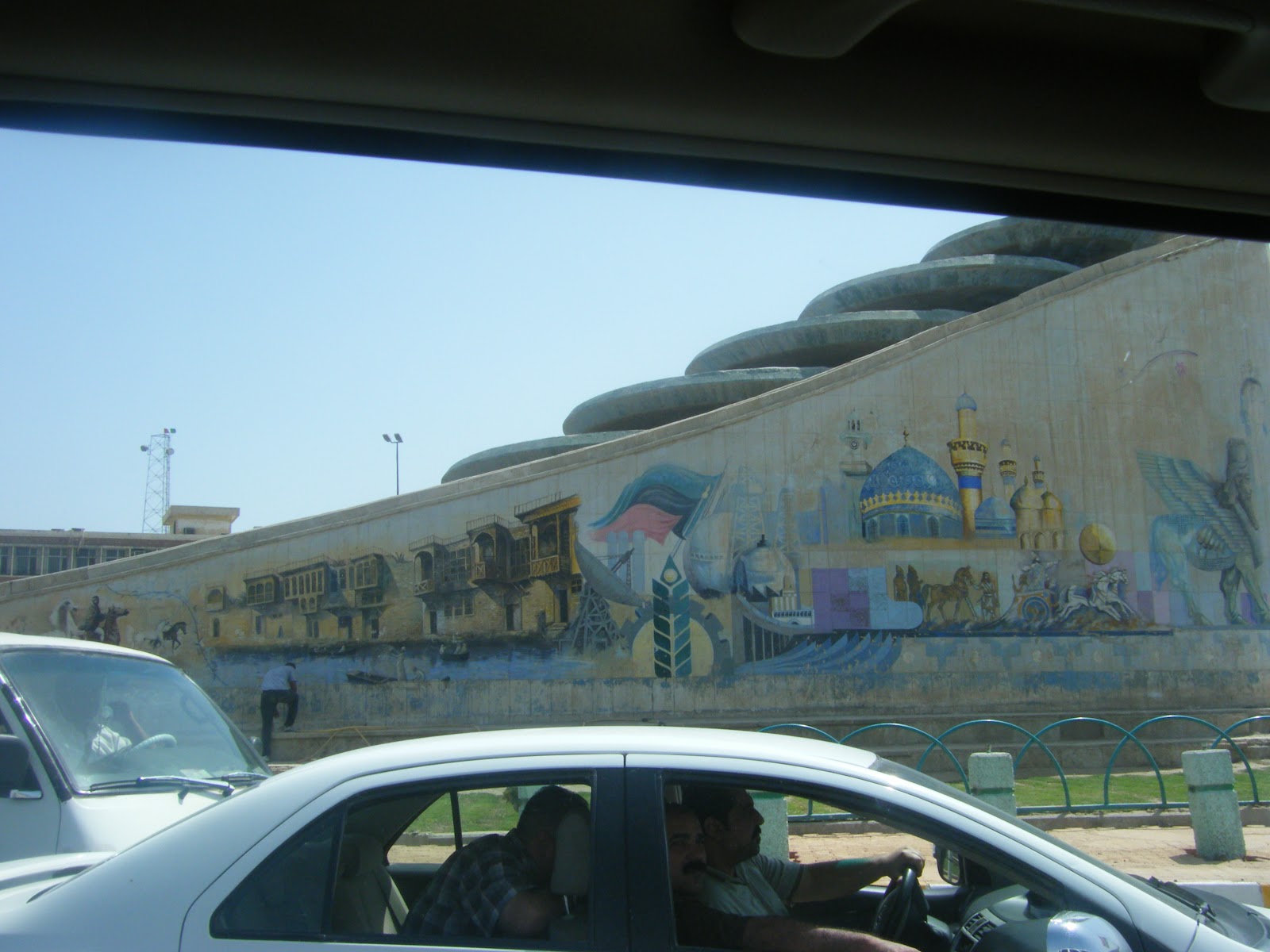
Saad very kindly lent me his car and driving team to take me from INLA to the Iraq Museum and then back to the British Embassy. Here are some shots taken from the car window as we crawled through traffic.

There's surprisingly little construction in Baghdad still (outside the INLA compound), presumably because corruption and insecurity make the costs and risks too high. So the city still looks very war-torn, ten years on, but there's a huge amount of small-to-large-scale enterprise in evidence.

Note the new red double-deckers, which arrived 5 or 6 months ago. (They were quite a feature of pre-war Baghdad too.)

Lots of delicious-looking street food for sale:

A public monument (covered in heritage images), mosque and the railway terminus, all by the Iraq Museum, which is adjacent to a furniture-making quarter. (Traffic was much lighter here, so my photo isn't great.)

Tuesday, 9 April 2013

Memory, identity and grassroots democracy at the Iraqi National Library and Archive

Sunday 7 April

(Updated with a few more images on 10 April)

Without memory, how can we know who we are? This is the question that drives Dr Saad Eskander, LSE-trained historian and, since 2003, Director of the Iraqi National Library and Archives.Saad talks passionately of the imperative to locate, preserve and digitise as much as possible of Iraq's documentation so that history will not just remember the oppressors but also the oppressed.

But Saad does not just talk: for the past decade he has also been putting those words into action in many different ways. The books lining his elegant office were once owned by the Iraqi royal family and then passed into the hands of Saddam Hussein. The glamour of their bindings reminds me a little of King George's Library at the British Library. But conspicuous amongst them are a much tattier pile of books lying on their sides, in clear need of rebinding and conservation. These are an important national collection too but had been long neglected because they are written in Hebrew, not Arabic. It's Saad's mission to safeguard all of Iraq's written heritage, whatever its origins.

He takes me on a whistlestop tour of the departments, sleeves rolled up and coffee mug in hand. In one large office, staff are digitising microfilms of state records; in another they are scanning the personal files of those executed or exiled by the Baathists: Jews, Iranians, political dissidents, anyone thought to be a trouble-maker. The dictatorship's passion for bureaucracy at least means that the oppressed have not disappeared entirely without trace. There is at least a little comfort in that thought, and much poignancy in the forlorn photos looking up at us.

A third suite of labs and offices is devoted to the restoration and digitisation of Ottoman court records. They are horribly mouldy, so are stored in freezers before being disinfected, cleaned, flattened and dried. Then they are mounted into books of Japanese paper and scanned. There are Monarch-period documents on the drying racks too. It's this team who trained Mr Kamal's conservation lab in Kerbala.

Another office, another preservation exercise. This team is processing Mandate-period records. I pick one up from the top of the nearest pile; it is a handwritten telegraph despatch asking the reason for the imprisonment of a certain local sheikh. A detailed reply is on the next sheet down. Maps and photographs are stored in a separate office. By and large they need less conservation work.

Digitisation equipment has also just arrived for the Sound of Iraq project, which BISI has helped to fund along with the British Library. The BL have been training sound technicians to transfer vinyl and shellac records of traditional Iraqi music and poetry to digital media. However, INLA hasn't abandoned traditional media altogether; some documents are still being photographed onto film as well as being scanned.

There's a huge foundation pit within the INLA compound, which will before long become a four-storey digital library. A recently completed archive building will house the ongoing digitisation work and receive visiting researchers. But the aim is to put all of the material online too, so that it can be accessed free from anywhere in the world.
The library, which is currently full, will then expand to gradually fill the existing building. As a copyright deposit library, it has a right to a copy of every book and periodical published in Iraq. It also publishes three or four journals of its own and runs an exchange programme with institutions in other countries. The library catalogue is online, and the reading room welcomed over 20,000 visitors last year. A dedicated children's library has just been built and is currently acquiring its first stock of books (below).

All this activity, and it's not even 9am yet! Saad knows all his employees by name, because he has hired them all personally and takes a close interest in their welfare and personal development. There are two nurseries onsite, as well as a canteen. The majority of the technical staff are women (Sunni and Shi'a, Arab and Kurd) and Saad urges them to be independent, critical thinkers--at home, as well as at work. The staff themselves hold annual elections to choose departmental heads, and selected Saad's own office team from amongst themselves.

INLA also puts on cultural performances and exhibitions. Most movingly, Saad has just received a large white box in his office, which he opens once our tour is over. Inside are all the original artworks from the international anthology, Al-Mutanabbi Street Starts Here, put together in commemoration of the bombing of the Baghdad booksellers' market in 2007, and which has also toured as a performance and exhibition. Soon it will return to the street which inspired it, which Saad tells me is now thriving again.