Saturday, 6 April 2013

Cake and fun at the mathematicians' party

Wednesday 3 April, evening

It so happened that this year's cohort of graduating mathematicians were receiving their degree certificates this evening, so Dr Mansoor and his colleagues very kindly invited me along to the party.

It was an outdoor event, held in the grounds of one of Saddam's former palaces, on the banks of the Euphrates. The building is now managed by the governorate, and used for all sorts of public occasions. It was too dark to photograph the building well, and I can't find any pictures of it online, but this rather blurry Google Maps image shows its extraordinary shape, overall whiteness, and--if you zoom in further--you can just make out the two modernist gold domes on either side of the entrance.

We drove there along the riverside road, a sort of corniche lined with outdoor restaurants and brightly lit cafes, clearly the centre of Kufa's nightlife. Lots of smartly dressed young persons and their proud families were pouring out of the carpark, clutching elegant white invitation cards.

I was given a seat in the front row, next to the Dean of the Faculty, with Dr Nazera and Dr Mansoor beside me. It was the perfect place from which to observe the occasion, a mixture of student-led jollity and silliness with formal ceremony. Much wild dancing from the young men to left of the stage, lots of jokes and skits and spoof videos (from both sexes) on stage. The graduating cohort call themselves "The New Numbers" (in English) and for the more serious parts of the evening wear slim-fitting academic robes banded with green, plus large mortarboards which nevertheless perch somewhat precariously on the girls' hijab.

Particularly supportive family members are presented with roses by grateful students. The Dean makes a speech (which I'm afraid no-one much listens to). Teachers also get certificates and thank-you gifts, presented to them individually by the students. Dr Mansoor gets an especially loud cheer when he goes up to receive his. "I've got a pile of them this high now", he whispers on his return.

The governor of Nejef arrives half-way through the evening to present the awards. "He's standing for re-election", my hosts whisper, "Politicians are the same everywhere." But later they also tell me that he's done a lot of good for the city and they rather like him. He's yet another UK returnee. It seems as though our Iraqi refugee programme, resented though it sometimes was at the time, has turned out to be a significant factor in post-war capacity building.

Both Nejef and Kufa are drowning in electioneering posters, in fact, for the local elections later this month. Enormous, brightly coloured, featuring the candidates' portraits (male and female) and their candidate numbers festoon all the main streets and bridges. My hosts are much amused by one woman standing for election who is using her husband's photograph instead of her own. "Who are we actually supposed to be voting for? Why doesn't he just stand himself?". (Here's a nice report on election posters from Al-Ahram newspaper but no pix unfortunately.)

It's just as well there have been group photos taken earlier in the evening, however, as the governor's team of minders, together with the local film crews, make it impossible for us to see the actual moment of presentation. Each graduand emerges from the huddle beaming, though, clutching not only their degree certificate but also a box containing high-end smartphone.

Finally, the governor starts to cut the fancy cakes that have been the centre of my fascinated attention all evening (them and the Christmas-tree decorations). More photos, of students, families and teachers in various combinations, and then it's finally time to go home, full of cake, coca-cola and optimism for the New Numbers and the rest of their generation.

Friday, 5 April 2013

Fishy business

Wednesday 3rd April, afternoon

I first had masgouf in Baghdad before the war, in a restaurant on the Tigris. Then it was barbecued outside and took almost forever—lots of grumpy jokes about how the Sumerians must have out while waiting for their fish to cook. It's a big delicacy here in the south, though in Kurdistan last May I was told that Kurds never eat it (not quite true, I've since discovered). It's really delicious, though somewhat dangerous as it always comes fully boned. (Siham says there's a saying here that you haven't eaten fish until you've bitten bone. She also says that it's not the one thing to drink water with it, though I did. It is the done thing, however, to follow up with delicious melt-in-the-mouth dates; did that too!)

So it was a real treat to go to a traditional masgouf restaurant here in Kufa, as the lunch guest of Dr Akeel Abd Yasseen. The restaurant surroundings are pretty basic, but it's the real deal, and all the cooking is done in the public courtyard. There's always food in the oven, so waiting times are minimal.

Live fish are kept in the tank and scooped out as needed. There are two wood-fueled tannours for baking the fish, and one for cooking the bread.

The fish are halved lengthways, gutted and wrapped in foil. Then they're flattened between large metal tong-like instruments and inserted into the tannour. Some people like the innards and eggs too, but they're always baked separately, with onions and tomatoes.

Bread dough is left to prove under a cloth and then expertly flipped around in mid-air to stretch it out. Then the baker slaps the dough onto the inside wall of the tannour using a cushion-like oven-proof thing (my vocabulary is failing me here!) and pulled out again once the air bubbles start to burst.

Siham's family were potters by trade, until her grandfather's time, and made tannours like these. I wonder who, if anyone, is making them now?

I explained to my hosts that I was making scientific photos of traditional craft practices; they laughingly insisted I photograph the traditional cashier too.

And then we ate it!

Next up: that evening's graduation party.

University of Kufa campus tour

Wednesday 3rd April

Frustratingly, my 8am pick-up didn't transpire this morning, as the driver overslept. We finally got going at 10 o'clock with a tour of the mathematics department, followed by a visit to archaeology and a lunchtime meeting with the University's president. We ended the day at the graduation ceremony/celebration for the 30 mathematics students who have just completed their BSc's here. But the fish, cake and (fizzy, not snorty) coke parts of the day deserve a post to themselves

The university is on a green-field campus half-way between Nejef and Kufa. It was founded in 1987 but was closed down for a few years by Saddam after the 1991 uprisings and then stagnated (as did many Iraqi institutions) during sanctions and the first years of post-war instability. But in the past five years or so the university has come to life again. It has a pretty decent English-language website, which is worth checking out.

The mathematics department, for instance, was created in 2008, as one half of the Faculty of Mathematics and Computer Science. It has five clean, bright classrooms, four of which were in use while I was there, plus a lecture hall which seats 150 and a newly-refurbished graduate seminar room with data projection and interactive whiteboard. The library was full of studious young persons, and they manage to keep up with textbook purchasing. The teaching staff whom I met were all energetic and committed. Statistician Dr Nazera Dakhil, for instance (the woman in the photos with me), splits her life between here in term-time and home in St Albans during the university vacations. Several of their students are winning scholarships for further study in the UK and elsewhere, of whom they are justifiably proud.

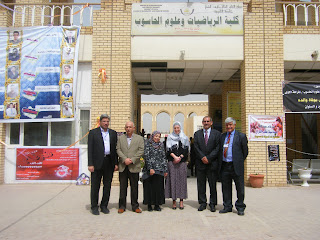
Jolly archaeologist Dr Ali Naji is back far right in the first photo; far left in the second. He was there to make sure I actually got to Archaeology and the mathematicians didn't keep me forever! Dr Mansoor is second left (first) and far right, apologising profusely for the delayed schedule. Dr Nazera is next to me; plus the Dean (striped tie) and Deputy Dean (beige jacket) of the Faculty.

Compared to my own Cambridge department, however, there are a surprising number of administrative and other support staff, who seem to be rather less busy than their UK counterparts. My colleagues were surprised to discover that I don't have a secretary, for instance. The secretaries I've seen here in Iraq, in universities and cultural heritage institutions, mostly serve as gate-keepers and status symbols, as far as I can see. As discussed at the Chatham House conference session on National resources and the Iraqi economy, the majority of state spending is still on salaries, and job creation is one of the few remaining sources of central government legitimacy.

Once I'd greeted everyone in maths, I was whisked off to the old campus to meet the archaeologists. We were running so late that we had to speed past the excavations of the old city of Kufa--founded in just 16 AH (637 AD). I never got a chance to see the great mosque of Kufa either, but that's a good reason to come back another time.

The archaeology and cultural department's housed in a former hospital. Sadly I had hardly any time there. A quick chat with the Dean, Dr Taher Al-Waely, in his office with gold-brick wallpaper, about the frustrating lack of cultural heritage legislation at a time when huge construction projects are going up all over the place. Then to my lecture, which I had cobbled together from a course I used to give in Cambridge, given in another very well appointed lecture room.

In the front row are Dr Mansoor (far right of first pic), Dr Siham and Mr Mu'amal (second pic). The Dean of Archaeology and Dr Ali Naji flank me on the podium. Note the fancy projection screen above the banner made in my honour! (There are lots of banners here.)

I'd been asked to speak on European views of ancient Iraq, so I gave a simple history of the origins of Assyriology. I talked about the importance of Classics and Biblical study in the early 19th century, and the unfavourable views they presented of their threatening eastern enemies/neighbours. I also talked about the geopolitical importance of the region as a potential shortcut to India and the Far East, so that the earliest systematic explorations related to mapping and surveying. And then I gave a quick overview of the professionalisation of archaeology: from collecting beautiful and curious things for museums to systematic, documented stratigraphic excavation. My aim was to explain why Westerners had become interested in the first place, how entangled in politics Assyriology and archaeology have always been, and how Biblical and Classical obsessions focussed attention on the ancient rather than the Islamic past.

It generated a gratifyingly lively debate amongst my colleagues but frustratingly I got whipped away again, this time to meet the president of the university, Dr Akeel Abd Yasseen. A geneticist with a PhD from the University of Ulster, he took over the presidency a couple of years ago and has been vigorously engaged in improving the university's national and international standing. He's particularly keen on improving the (British) English-language abilities of his students and staff and on providing facilities for visiting researchers.

In the president's office, standing l-r: Dr Ali Naji; expat Professor Ramzi Mahmoud of California State University, Sacramento, fellow conference-attendee whom everyone teases because he's half-forgotten how to speak Arabic; QA director Dr Ahmad Al-Imarah; the Dean of Sciences, with a PhD from Cardiff (I love a Welsh Iraqi accent!); Dr Mansoor, Dr Abbas (see below); seated, l-r: Siham, me, Dr Akeel, and (second right) Professor Mohammed Al-Rubaie of UC Dublin.
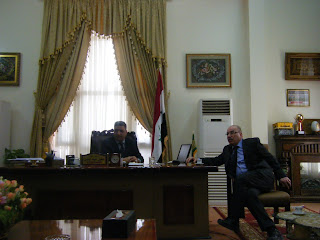
Ramzi and Mohammed are regular visitors and advisors, another way in which Iraqi academics abroad contribute to their country's academic regeneration. Here Dr Akeel and Mohammed share a joke. (There are always lots of jokes.)
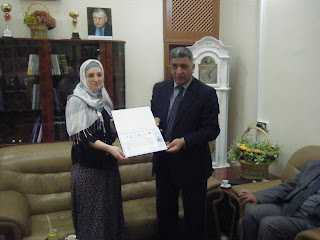
I am presented with my certificate of conference attendance—which has to be reprinted twice because Dr Akeel rightly won't stand for typos in the English, whether of "Kambridge" (as in Kufa, of course) or of his own name and title!

The university's advisor for international relations, Dr Abbas Al-Aboudy, was also at the meeting. He's a more recent UK returnee, a practising surgeon with plans to expand the teaching hospital here, with a special focus on paediatrics and neonatal care. There's a deep well of Anglophone Anglophilia amongst older-generation Iraqi academics, plus the youngsters who are now going out on scholarships. BBC World was on mute on the big flat-screen TV in Dr Akeel's office and at one point the conversation turned to the relative merits of Eastenders vs. Coronation Street!

(A blast from the past at one point, when an enormously fat military man came in, sporting a huge, and now deeply unfashionable Baathist moustache and a giant turquoise ring. He had a leisurely chat to Dr Akeel and then wandered off again; his presence remained entirely unexplained. I wish I'd had the cheek to photograph him...)

On our way to lunch, Dr Akeel took us to see the new guest house which is about to open, comprising several well-appointed apartments and even a gym in the basement. Next stop was a new staff canteen neear the university library--there's currently nowhere for staff to socialise or eat together. There will also be a bank and a supermarket nearby. Stupidly, I had left my camera in the car so I can't show you any of this. But as far as I could tell, all of these projects are being finished to a higher standard of taste and quality control than one often sees here. And it's very interesting that the university is investing in this sort of research support infrastructure. It's streets ahead of poor old Qadissiya university, which I visited last October.

Next stop: an authentic masgouf restaurant: yum!

Old Nejef: khan, souk and shrine

Tuesday 2nd April (evening)

Yesterday's group outing to Nejef city centre took in the old caravanserai Khan Shailan, some of the souk, and most importantly the shrine of Imam Ali, the prophet's son-in-law and cousin and the fourth caliph, who ruled from nearby Kufa and was buried here in 40 AH (661 CE). That was pretty amazing for me as a historian as he represents the very beginnings of Islam in Iraq.

At the other end of the historical scale, Khan Shailan is an Ottoman-period caravanserai, or inn, in which ten British soldiers were imprisoned during the 1920 uprising against the British occupiers. The building had fallen into disrepair over the 20th century, compounded by shell damage during the 2003 war, and earlier concrete "restoration" which had collapsed. Local archaeologists and civil engineers have just finished a rather splendid restoration project on it. There are now plans to turn it into a museum of the uprising.

Dr Ali Neji introducing us to the building

The main courtyard (with, below, Dr Ali Hassan and Dr Ebtisam the computer specialist, with whom I discussed mentoring women academics yesterday; and my lovely translator Dr Siham).

Lots of beautiful traditional brickwork, including some impressive (restored) ceilings and the charcoal sketches left by the British soldiers: mostly head-and-shoulders drawings of people but also a rather sad-looking horse. One of a young woman in a hat, whom the archaeologists say must have been the fiancée of one of the captives! The tour was led by the knowledgeable Dr Ali Naji Attiyah, and Mr Mu'amal, who are closely involved in the restoration work here and in the rest of the old town. Mu'amal (whose hand you can see pointing to the sketch) wrote his MA thesis on the building.

It features traditional air-conditioning features: open-topped rooms which act as ventilation shafts to draw air in from the roof, and a sirdab, or basement, which is naturally cool in summer and warm in winter. We couldn't go down, as it's still full of construction equipment, but could feel the drop in temperature even from the top of the stairs.

On the way to the shrine we passed through the souk, mostly just the usual clothing, shoes and housewares, plus large mounds of sticky pastries and sweets. But there were also some very fine silver and goldsmiths near the main entrance to the shrine. Here and there one can see glimpses of old walls, including the now rather delapidated remains of a once very prominent madrasa (first photo below).

Night had fallen by the time we reached the shrine, whose entrances were crowded with people. Pilgrims regularly come from Iran, Pakistan, and all over the world. Apart from the brightly lit gates there's not much to see from the outside, and indeed no obvious vantage point to see it from, as there are no large open spaces around it. Rather, all the action, and all the splendour, is on the inside.

At the shrines of Imam Ali and Imam Hussein in Kerbala, I took copious photos as that was what I was there for. It wasn't so appropriate to do that this time, so I don't have any pictures of the main courtyard, apart from the few that Dr Ali took of me with Siham and Ebtisam. I can't find any decent pictures of the courtyard on Google either. But it is similar in scale to Imam Ali's shrine in Kerbala, though with a rather different colour-scheme to the tiling. Here the emphasis is on yellow-gold, with recessed panels of cream and green. Most is relatively modern but Dr Ali Naji pointed out two large panels of very fine Safavid tiling higher up, on the central building surrounding the shrine itself. The archaeologists persuaded the shrine authorities not to replace these, even bringing in an expert from Iran to explain the historical uniqueness of the dusky pink glazing that they feature.

In the reception room at the back of the shrine (where later we drank lemon sherbet and I quietly coveted the carpets), Dr Ali showed me the restoration and preservation project that they are implementing in the old city. At the back of the shrine (to the right in the photo), during the Saddam era a huge swathe of buildings was swept away to make way for an underground car park. A gigantic pit was dug, without any archaeological recording. (We walked past it later in the evening: it is enormous and one can see the remains of graves in the sides.) This area will now become extension to the mosque which will pretty much quadruple its size. This will provide facilities for the many millions of pilgrims and visitors the shrine receives every year. There are also plans for the heritage buildings in the old town too (which are the darker ones on the plan), so that they don't get demolished to make way for pilgrim hotels and the like.

Perhaps the most moving part of the visit, though, was when Siham took me through the women's entrance to see (and touch) the tomb of Imam Ali himself. Many of the women surrounding us had come hundreds, even thousands, of miles for this, often at great personal expense, and the intensity of their emotion was palpable (as indeed were some of their elbows). For Siham, and some of the other Nejefi women academics I talked to, the shrine is an integral part of their lives. It is a place to come for contemplation and reflection (more easily achieved in the outer courtyard, where it is easy and natural to establish private space), especially in times of trouble or stress. (No doubt many men would say the same; but I haven't tended to have those sorts of conversations with them.)

Given the upheavals of the past few decades, the lives lost and the families broken, I can see how vital Shi'a Islam has been in healing indeividual sadness and anger. In the shrine I was also reflecting on Hayder al-Khoei's words at Chatham House the other week, about how tolerant the Shi'a population of Iraq have been in the face of repeated Sunni attacks on their places of worship over the past decade. (It's the main security risk now: later, in Baghdad, one of the Embassy security staff briefs me that the only real targets these days are Shi'a gatherings outside the holy cities, and high-profile election candidates.)

As we leave the shrine, at about 9pm, it suddenly hits me that I have been awake for pretty much 36 hours non-stop now. I beg off dinner and don't even manage to stay awake in the car to the hotel. Somehow I have to get a decent night's sleep and prepare a half-hour lecture for the Archaeology department (on European views of ancient Iraq) before 8am tomorrow morning...

Thursday, 4 April 2013

Arrival at the University of Kufa

(The internet at my hotel in Nejef had an uncanny knack of dropping just when I wanted to use Blogger. So I've been writing offline and will catch up with myself over the coming day or so in Baghdad. )

Tuesday 2 April 2013

Coming into land at Nejef at first light this morning, the flat, flat landscape below looks strangely reminiscent of the fenlands I've just left: bright green strips of field separated by narrow watercourses glinting in the early sun. It's only once we get really low that the riverside trees resolve themselves into date-palms not willows. And then there's the fact that it's a balmy 20º C here already, not yesterday's subzero howling winds.

Hurrah for tiny Nejef airport's efficient immigration service (and hurrah for the kind man behind the visa desk at the Iraqi Embassy in London last Thursday). Hurrah too for Turkish airlines' delicious food but most of all hurrah for the besuited welcome party who met me at the baggage carousel at 6am. My host for the next few days is avuncular mathematician Dr Mansoor Habeeb (below), whom I met in Kerbala last October, most of whose family now live in snowy Bradford.

Managed a half-hour semi-doze before breakfast and the arrival of my new hijab consultant and translator, the delightful Dr Siham Al-Qawwaz. Magenta leopard-print is so last season but my new Accessorise butterflies pattern got vetoed too, and I was politely but firmly put into an elegant grey-and-pink check, which happens to match my suit absolutely perfectly. Siham herself (whom I haven't photographed yet) is in a black jilbab (floor-length gown) with seriously chic crystal trim. She's a comparative linguist, working on puns and figurative imagery in both Arabic and English, wanting to start publishing in international journals. Not my field, sadly, but maybe someone reading this can give her some practical advice?

The pretext for this visit, as for the last, is a conference, this time on Quality Assurance and Accreditation in Iraqi higher education. 600-odd attendees, including two jolly expats now teaching in Dublin and California respectively. Opening session was the usual mix of worthies' speeches, powercuts and techno-shambles, plus the U.Kufa choir who launched energetically into the national anthem and the university song. A plethora of glitzy jilbabs plus suave conductor and OTT portable keyboard (just visible to the right), quite overwhelming!

Dr Mansoor did a fabulous job of translating my talk sentence by sentence, and then (mostly) fending off the crowd of people wanting to talk one-to-one. Instead I was ushered in to the office of Dr Ebtisam Almadany, the Dean of Education, where we discussed the problems of supporting women into senior management roles in higher education here in Iraq (she is one of three female Deans at U.Kufa). With us too was Dr Ebtisam Alkhammary, head of IT, and the charming Dr Hassan Ali (but everyone's charming here!), head of the postgraduate office, also attached to the Dublin Institute of Technology and a fluent English-speaker, who is championing their cause. Again, this is too much for me on my own, but maybe someone reading this might like to help mentor or support in some other way?

We were then joined by (all-male) team of Kufa archaeologists, whose department I'll visit and talk to tomorrow morning, once I've toured Dr Mansoor's maths department and Dr Ebtisam's computer laboratory. Here you see Mr Ahmed Al-Imarah, head of QA (far left), me and the two Dr Ebtisams, silver-haired Dr Mansoor, and various archaeologists (who didn't have cards and whose names unfortunately came and went before I had a chance to write them down.) Dr Ali had slipped away by then.

After the obligatory plaque-presentation ceremony and a slap-up lunch at a fancy restaurant—delicious rice with dill and broad beans and fantastic baked aubergine; no-one minded that I didn't touch the lamb shank—finally a chance to rest for a bit back at the hotel. I've worked out how to remove my hijab without taking the pins out, so that I can preserve Siham's handiwork and not look a shambles when we go to Nejef city centre this evening!

Wednesday, 3 April 2013

At Imam Ali's shrine

In lieu of a proper post—coming soon—here is me last night at Imam Ali's shrine in Nejef, with my new friends Dr Ebtisam (manager of the IT centre at U.Kufa) to the left and Dr Siham (linguistics lecturer) to the right. The photo was taken by Dr Ali, archaeologist and civil engineer, who gave me a fascinating tour of the shrine.

So yes, I am really here, and really having an amazing time. Proper posts will follow soon!

Monday, 1 April 2013

Ten Years On at Chatham House: from Collis to Hollis

While I'm whiling away the hours until my connection to Nejef, I thought I'd make the most of Istanbul airport's cheapo wifi—€1 flat rate!—and mains power to write a quick report of a brilliant but sobering conference organised by BISI's near neighbour Chatham House held on 19 March, called Iraq: Ten Years On.

There are copious videos, audio recordings and transcripts on the Chatham House website so I'll limit myself to reviewing a few personal highlights. The first, most obviously, is that CH kindly gave BISI co-sponsor status in exchange for some advice on the programme. Our logo was bottom centre on all the big screens, much to our administrator Joan MacIver's delight.

Simon Collis, HM Ambassador to Iraq (and formerly to Syria) gave an excellent opening keynote, reminding us that the decade's retrospective should not be about hand-wringing or reliving old grudges against the UK/US politicians then in power: Iraq has moved on and so should we.

Indeed, common threads running through the day were optimism about Iraq's basic economic indicators and potential for future growth, intertwined with frustration at political intransigence, corruption and the endemic victimhood that fuels continued sectarianism. This last idea from the excellent Fanar Haddad in the best panel of day, on Iraq's political systems, chaired by recent BISI grantee Nussaibah Younis. Zaid Al-Ali on the Iraqi constitution and Haydar al-Khoei on Shia religious authority (confirming my positive impressions in Kerbala last October) were also very impressive.

The final panel of the day featured the incomparable Rosemary Hollis (far left), reflecting on the extent to which the Iraq war ten years ago should inform western government's responses to the current Syria crisis. Hollis also gave an impressively robust response to another panellist, Jeff Macris (far right—how apposite), who characterised the Gulf region as "endemically anarchic". Much to the audience's surprise, he blamed the region's current problems on the UK's withdrawal from the Trucial States in 1971, hinted that democracy was not a good fit for "the world's oldest societies" (as if they were still all Early Bronze Age city states) and urged the necessity of a (western) superpower to maintain order. Sadly I had to leave before the end of the question session but I sensed that Macris's neo-neoconservatism was not the majority view, thank goodness. CH's Jane Kinninmont (centre left) was chairing with an admirably tactful neutrality.

Last but not least, heartfelt thanks to Claire Spencer, head of CH's Middle East and North Africa Programme, and all her staff for putting on such a thought-provoking day and for making BISI a part of it.